


There exist many words whose meanings are opposites of themselves.
You may ask, How can a word be an antonym of itself? Through polysemy and homonymy, a word that is pronounced or spelled the same way can have opposite meanings. A word that is an antonym of itself is called a contronym.
A commonly known contronym one is dust (verb). The two opposite meanings of dust are:
1. remove fine particles: Please dust the drawers to keep them clean.
2. cover with fine particles: He dusted the cookies with sugar.
Seed (verb) is another one:
1. remove seeds from: Seed the watermelon before eating.
2. distribute seeds; to sow seeds
To "X" something is a phrase often used colloquially. Here are its opposite meanings:
1. select: X your desired items on the list.
2. cancel/eliminate: Please X out the items you don't want.
Monday, October 08, 2007
Same word, opposite meaning


Wednesday, September 26, 2007
Breaking words down in more than one way
There are some cases in which morphemes can be ambiguous.
Take the following word:
unionized
The more familiar meaning is "formed into a union". The other, less commonly known meaning comes from chemistry: "not converted into ions"; it's actually the word ionized with the un- prefix. This is an example of a homograph, as the words can have two pronunciations and different meanings altogether but are spelled the same.
The root words are different: in the first case, it's union, and in the second case it's ion. Here's the morpheme breakdown of both meanings of unionized:
unionized:
union : root word
-ize : changes a noun into a verb (union -> unionize)
-ed : past tense (unionize -> unionized)
unionized:
ion : root word
-ize : changes a noun into a verb (ion -> ionize)
un- : "not" (ionize -> unionize)
-ed : past tense (unionize -> unionized)
In the second case, notice that the order matters: the un- prefix is applied after -ize, as there isn't a word such as "un-ion".
Friday, July 13, 2007
Indirect speech acts and violating the maxims
Indirect speech acts are used all the time, they have basically become second nature to us. Here's an example:
A: Has the boss arrived today?
B: The light's on in his office.
Notice that speaker A has asked a yes/no question. However, speaker B did not follow up with such a reply. The point here is that B has just violated one of the aforementioned Gricean maxims (relevance). But is B's response irrelevant?
The short answer is no. We do not take everything literally, so this response makes sense (of course, this assumes the boss doesn't leave the light on when out of office!) This is just one out of many cases of an indirect speech act. These such acts violate at least one of the maxims. Good listeners/speakers notice that the maxim is intentionally being violated, and can identify its intended meaning with the knowledge of the context of the situation.
Thursday, June 14, 2007
Negative prefixes adding no meaning?
There are words in English that can take a negative prefix, such as in-, and the meaning of that word will remain the same. Is there really a difference in meaning between these such pairs of words? Let's examine a few:
valuable vs. invaluable - These words can have slightly different meanings depending on the situation, although they can be used interchangeably without much difference. Valuable things have a known value, and invaluable things are those "of value too great to be estimated". A good way of remembering this: invaluable items have value that is inestimable.
flammable vs. inflammable - These words have identical meanings. Inflammable actually comes from the root word inflame, and it is not supposed to be a negative prefix. The word inflammable is being phased out, and rightly so; it just isn't worth the safety risks involved.
regardless vs. irregardless - Again, no change in meaning. Considered nonstandard as it is a double negative; the -less suffix already puts it in the negative, no need to add a negative prefix.
Monday, May 21, 2007
Foreign expressions misinterpreted?
When English borrows certain expressions or phrases from other languages, we are sometimes not used to those expressions and have some trouble spelling or pronouncing them.
Here are some examples of expressions that originated in French that are now used in English:
tout de suite: "Right away" or "at once". Often misinterpreted as "toot sweet" (shown in the above picture), it refers to something that must be done right away.
Example: You need to be at the meeting tout de suite.
faux pas: Means "false step" in French. Refers to a blunder, error, or foolish mistake.
Example: If you add fake information to your portfolio, you've committed a faux pas.
voilà: Means "look there!" or "behold!" It is pronounced "vwala" but you shouldn't write it that way! Often used as an attention grabber and also indicates that something is finally done.
Example: Just finish mixing all the ingredients, and voilà!
Tuesday, May 15, 2007
Translation Trouble: Polysemy
Do you sometimes wonder why certain materials are badly translated? This is due to polysemy: the many meanings that a single word can take.
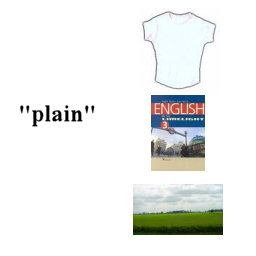
For example, In English, the word plain can take on the following meanings:
- ordinary / undecorated: a plain white shirt
- easy / simple to understand: plain English
- a level area of land: great plains
It gets more complicated when translating English into other languages.
For example, there are over 20 ways of saying "to get" in French. This is because there are multiple meanings of "get" that are used in English, but the French must use a different word for each of those meanings. It isn't that obvious, but this can give translators some trouble.

At elementary levels of French, most are taught the verb obtenir ("to get"). But which sense of the word "get" is really used here? Obtenir is used when something is acquired (it looks like the English word obtain). A different word must be used if you want "get" to take on a different meaning.
In each of the following sentences "get" takes a different meaning:
- I need to get some bread. (buy)
- I get the idea. (understand)
- We need to get home. (arrive)
This is just one word out of many which can cause translation difficulty. One must study the context carefully and do not try to translate word for word, or even worse, rely on an automated translator.